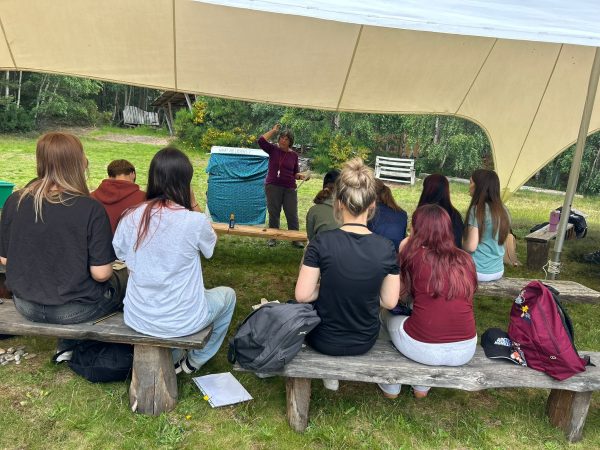
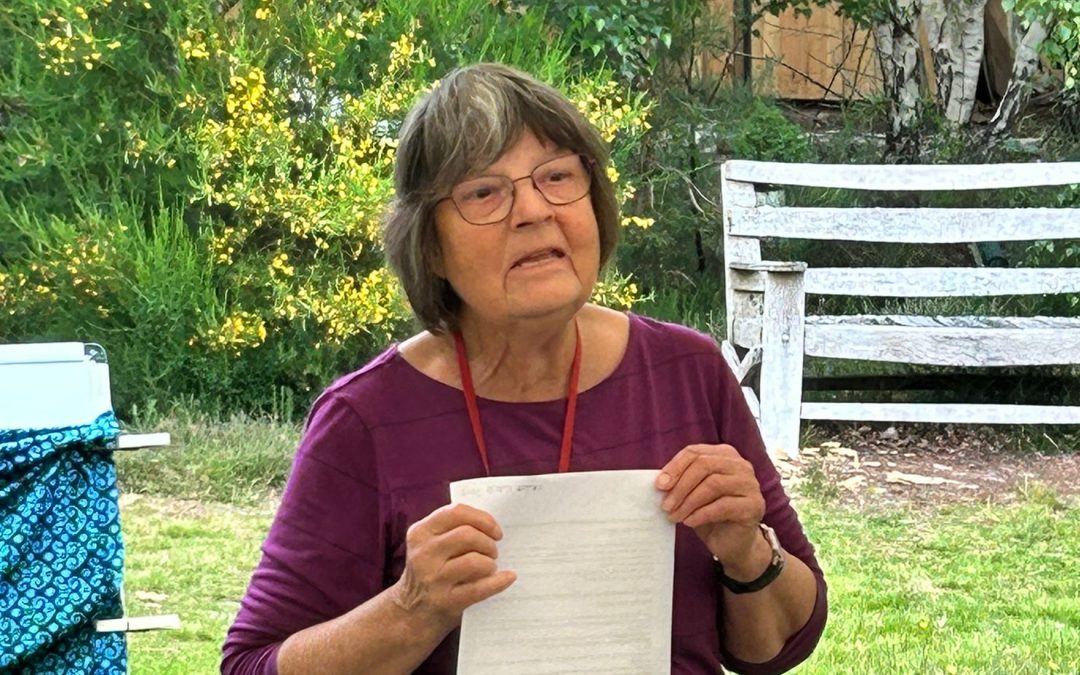
Heather Paul went from being curious about ‘these blobs on rocks’, to becoming a specialist in the field of lichens. She’s one of our most dedicated volunteers, and FHT’s resident lichen expert. Here’s her story:
Tell us a little of your story – where are you from, what led you to where you are now?
I was born and lived in Wales until I was 18, and then I travelled around, partly in England, mostly Yorkshire and Leicester area. After I married George – who is also a member of Findhorn Hinterland Trust – we moved to Botswana. We lived there off and on for four years. I trained to be a social worker and then in 2003 we decided to go to Scotland. I began working at Dr. Gray’s hospital in Elgin, particularly with people with dementia. By the time I retired I had become fascinated by lichens, after going on a holiday in the Western Isles. I wanted to know what these blobs on rocks were!
Was it the lichens that encouraged you to explore the natural world?
No it was before then. Where I grew up we had a field next door, and a wood at the bottom, and I spent most of my childhood either up trees, hanging upside down off branches, or out looking for wild mushrooms, or irises, or all sorts of things. And I enjoyed learning about flowers and plants.
What fascinates you about lichens, this field you’ve chosen?
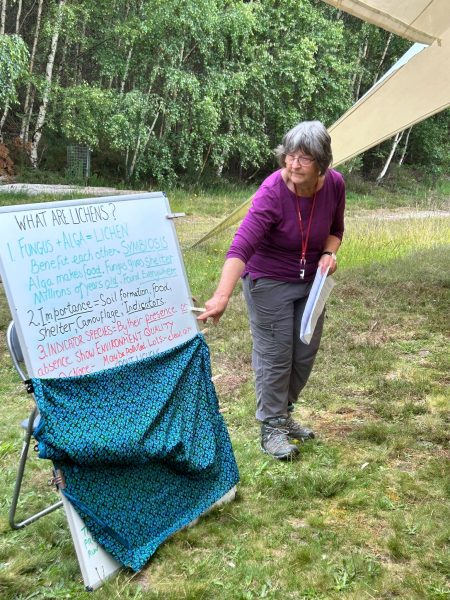
I wanted to know more, and I happened to find a book in Stornoway – it’s not easy to find a book about lichens that’s written for the ordinary person, as a lot of them are quite scientifically based. I thought it was really interesting, and then I saw a seven-day field studies course about lichens, with two of the people who were very, very involved in lichenology in Scotland. It was a total eye opener. I’ve spent the last 20-odd years now just wanting to know more.
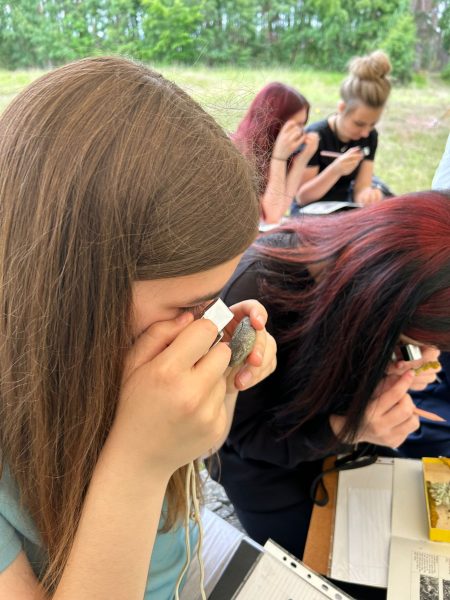
I suppose it’s a little bit like a detective thing – you want to know what you’re looking at. So I use microscopes to do that. I can look right inside them – being mindful of not removing lots of lichen, because lichens need to exist where they are. But I do take small amounts home, and I look inside them, and it’s like a magical world. You see how they’re made up. You see the spores, you count them, you see the colours, you see the divisions in them. It’s fascinating.
What drew you to the Findhorn Hinterland Trust?
Well, I got involved because I saw an advert asking people to join, and I thought, this might be interesting. Over the years I’ve taken part in work parties, and for a short period I was treasurer. I’ve become increasingly drawn to the work I do with lichens, and what I would really like to do is to pass some of that knowledge onto others, because a lot of it is in my head, and I am aware that one day I won’t be here. So I would like to share – not the full range of what I do, because you’ve got to choose to go down that route – but just enough so that people can actually continue to spread the word about what is here.
I’m also interested in how lichens relate to other species – the beetles, the spiders and everything else.
If you could dream anything for FHT, what would it be?
Well, I would hope it continues to flourish, and that people carry on with the work we’re doing. I think we’re gathering an important resource regarding species, not just lichens, but all the other wildlife that we’re slowly learning about. And I hope it will be of use. It’s no good if it’s just information we hold. We need to put it all together and learn from it and share it – hopefully locally and nationally. We’re adding to the understanding of the natural world, as well as looking after it.
Heather was chatting with Dell Horler