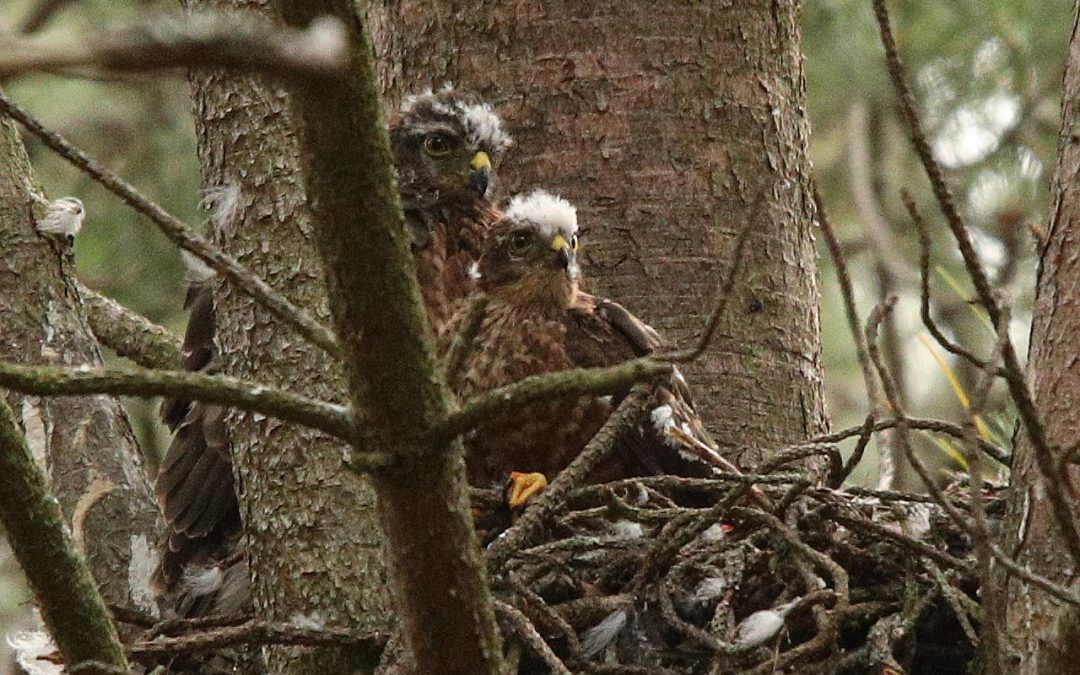
After years of seeing signs that Amber-listed sparrowhawks were present in the Hinterland, FHT Trustee Alan Watson Featherstone was finally able to photograph a breeding pair and their chicks.
I’ve seen the evidence of sparrowhawks on the Hinterland for a number of years, through finding the feathers of their prey, such as great tits and redwings, at the sites where they were killed. However, I hadn’t seen the birds themselves until this breeding season, when we were delighted to discover a pair nesting on the Hinterland, high up in one of the pine trees in our woodland, where they successfully reared three chicks. I was able to watch them on a number of occasions, and it was wonderful to see their development into almost fully grown birds before they fledged.
Interestingly enough, I had a remarkable experience in the middle of April, when I saw a female sparrowhawk with a collared dove she caught right outside my house. I was able to watch the drama through the window in my conservatory from a distance of less than two metres! This was almost certainly the female of the pair that nested on the Hinterland, as my house is only about 200 metres from the Hinterland woodland and sparrowhawks have a home range of 300 hectares or more.
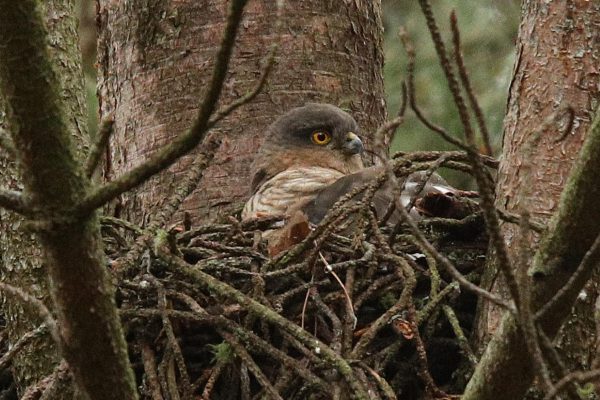
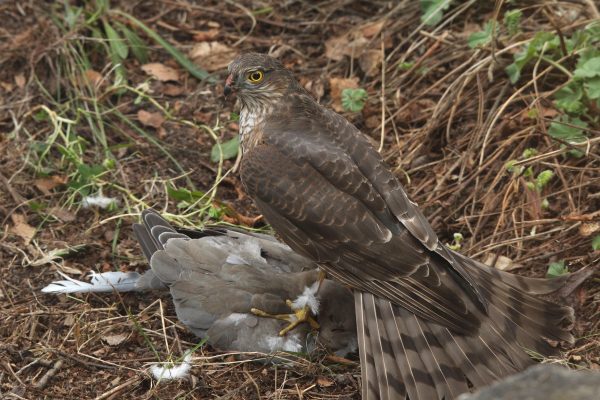
The sparrowhawk (Accipiter nisus) is a small raptor or bird of prey that occurs from Western Europe and North Africa eastwards to China and Japan. It can be identified by its bright yellow-ringed eyes, its yellow legs and feet, and the barred feathers on its long tail.
Although it is primarily a woodland bird, the sparrowhawk has adapted well to the presence of people in suburban areas and can often be seen in town parks and individual gardens. It feeds on mainly small birds such as finches, tits and sparrows, which it catches by flying low and fast through the cover of bushes and hedges, taking its prey by surprise when it suddenly appears, seemingly from nowhere.
The lifespan of a sparrowhawk is typically about four years, although some birds can live a lot longer – the current record for one in the UK is over 17 years. The population in the country today is estimated at about 35,000 pairs, and has rebounded after the banning of pesticides such as DDT, which had caused their eggshells to thin and their numbers to decline dramatically. However, the species is still on the UK’s Amber List of Birds of Conservation Concern because of recent moderate declines in its population.
The sparrowhawk is notable for its sexual dimorphism, whereby the female is about 25% larger than the male. This is one of the largest size differences between the sexes of any bird species, and it enables the female to catch larger prey than the male. Sparrowhawks normally have one brood each year, in a nest that is made of twigs high up in a tree, and the brood size ranges from three to five chicks.
Although some people may dislike them because they take garden birds they are fond of, sparrowhawks fulfil an important ecological role and are beautiful in their own right.
Alan Watson Featherstone, Findhorn Hinterland Trustee
Brilliant! Thank you.